A Policy Brief by the Holistic Edvisor Youth Research & Policy Lab
Aliza Akram, Emaan Mir, Fatima Atif, Minal Vaqas, Suleha Khan
Executive Summary:
This policy brief explores how Karachi’s public and cultural spaces can become more accessible, engaging, and meaningful for young people. Drawing on primary field
observations at Hilal Park and TDF Ghar, this paper evaluates how design directly influences
urban accessibility and visitor experience. Despite the clear social value of these sites,
Karachi’s public spaces remain constrained by broader challenges, including barriers to
accessibility and financial hurdles. Our field observations demonstrate that while restored
heritage venues like TDF Ghar offer culturally rich environments, the lack of physical
accessibility for example, the entrance fees, restrict full public integration. Moreover, while
public spaces like Hilal Park have outdoor amenities, they suffer from maintenance lapses
and critical infrastructure hazards such as open drainage.
Background of the Issue:
The UN-Habitat (2015) states that “As cities grow, the demand for housing, transportation,
education, healthcare, employment, and public infrastructure also increases. If this growth is
not matched with effective urban planning, public spaces can become overcrowded, poorly
maintained, and less accessible.” (UN-Habitat, 2015). To better understand how these
challenges affect young people in Karachi, the Youth Research and Policy Lab team
conducted field visits to MGB Park, Hilal Park and TDF Ghar to assess their accessibility,
safety, and inclusivity. Our findings highlight a broader issue in how public spaces are
planned and managed across Karachi, due to uneven investment. Addressing this challenge
requires coordinated action between policy makers, local communities, and citizens, not just
isolated fixes.
Research Question
Public and cultural spaces surge with connectivity and social cohesion, where a diverse range
of people can safely interact and engage with one another freely. Public spaces can also be
utilized as a “democratic equaliser” according to Ray Oldenburg’s “third place theory”
between the rich and the poor, slowly countering the challenges faced by rapid urbanization.
(Oldenburg, R. (1989). The Great Good Place. Paragon House.) To foster greater youth
engagement, public spaces should incorporate activities, such as outdoor sports, that
encourage participation and sustained use. Additionally, the area should be well maintained,
safe and clean.
Secondary Research Findings:
1. Heritage and History:
Tania Ali Soomro (2024) highlights that Karachi’s history is rapidly deteriorating as unchecked modern infrastructure distorts its unique South Asian heritage. Karol Krol (2025) shifts the lens towards the intangible cultural heritage by exploring how one’s heritage and local identities are preserved within daily, ordinary records. Masooma Shakir (2025) shifts the conservation debate to urban planning policy, analyzing how a lack of synchronized zoning laws in Karachi’s inner center forces a direct conflict of interest between aggressive real estate developers and heritage advocates. Shakir argues that the failure to establish “economic viability” for older structures leaves them vulnerable to high-rise commercial replacement.
2. Youth Engagement:
To ensure public and cultural spaces remain relevant, urban strategies must directly incorporate the uncensored needs and spatial choices of young citizens into civic planning. Jurgita Jurkevičienė and Paulina Budrytė (2025) address this disconnect by looking at the youth’s connection to modern urban environments. Their findings reveal that young people largely favor man-made environments optimized for social connection over natural green spaces. Carlos Smaniotto Costa, Joana Solipa Batista, and Marluci Menezes (2021) address the exclusion of adolescents from urban planning, explaining that when youth are given decision-making agency, they articulate clear spatial needs centered on autonomy and social comfort.
3. Cultural Spaces:
Farhat Niazi and Azra Parveen Azad (2018) illustrate how post-partition migration created distinct linguistic and ethnic culture, such as Urdu-speaking and majority zones, resulting in fragmented urban territories and spatial segregation. To make these spaces truly accessible
and meaningful for the city’s diverse youth, management frameworks must acknowledge these spatial-demographic divisions and actively design cross-cultural programming that transcends territorial boundaries, transforming historic hubs into shared domains for inter-ethnic dialogue and collective youth belonging. Torbjörn Forkby and Janet Batsleer (2020) investigate how youth construct “protected zones of experimentation” and “beloved communities” that break away from conventional adult oversight. Heritage constructors must market these locations as diverse areas where young people from varied backgrounds and ethnicities can build a mutual identity, and express their different cultural perspectives.
4. Infrastructure Management:
Arif Hasan (2026) observes that while new institutions and revived public spaces are reshaping the city’s cultural landscape, young citizens face severe obstacles regarding safe, affordable transit, high cost barriers, and inadequate public investment. For Karachi’s heritage sites, this demonstrates that physical existence alone cannot guarantee engagement: municipal planners must address infrastructural deficits. Financial barriers in infrastructure create deeper social divisions within Karachi’s public spaces. Marvi Mazhar, Uzayr Agha, and Ghania Shams Khan (2020) highlights how many public parks across the city now require high entrance fees, limiting financial accessibility. The report notes such restrictions exclude the lower-income class, women, and other marginalized groups.
Primary Research Methodology:
Primary data collection combined both semi structured interviews and direct participant observation.
● Semi-Structured Interviews: Standardized protocols were used to conduct semi-structured interviews. As Karatsareas (2022) notes, this method uses a combination of closed and open-ended questions, which allows for controlled data collection while giving respondents the flexibility to raise unanticipated localized insights.
● Interview Questions: Focused on visitor experience, accessibility, safety, community engagement, cleanliness and preservation.
● Direct Observation: Prior to each field visit conducted observation categories were formulated on the basis of pre-existing knowledge regarding the spaces. The observation categories included cleanliness, maintenance, accessibility, visitor behaviour, use of public spaces, safety measures, and overall condition of the sites.
Field Observations from MGB Park:
During our site visit MGB Park was temporarily closed for maintenance. However, we were informed that the park is generally open to all members of the community. The park appeared to be well maintained, with minimal visible litter. It contained two benches for seating, while trees provided shade. The presence of flowers and other plants further contributed to the park’s visual appeal (Figure 1. 1). Moreover, although the park did not have dedicated lighting, the surrounding streetlights provided sufficient light in the evening.
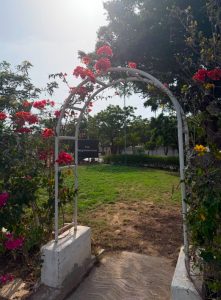
(Figure 1.1)
1) The park had several basic security measures in place. A CCTV camera (Figure 1. 2) was installed within the park and the surrounding neighbourhood was monitored by security guards. However, the signboard was broken, which made it less visible. Additionally, we observed litter outside the park. We also learned that responsibility for the park’s maintenance is shared by the local community. Residents of the neighbourhood contribute monthly financial contributions towards its upkeep, demonstrating a strong sense of community
responsibility.
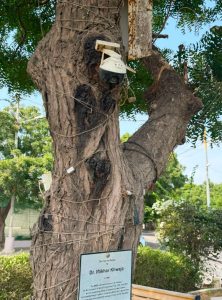
(Figure 1.2)
Field observations from Tdf Ghar:
According to Haneen Rafi (2017), TDF Ghar, established by The Dawood Foundation, is a restored heritage building originally constructed in the 1930s. Carefully preserved while being adapted for contemporary use, it retains its original architectural character and now functions as a cultural and educational space. Antique artefacts and collectibles from the past century are displayed, reflecting its historical and cultural significance. The building consists of three floors and has successfully preserved its original flooring, windows, woodwork and architectural features. The area was clean with no visible litter and an abundance of plants and greenery. Seating areas were available throughout, alongside an outdoor café (Figure 2. 1) that is frequently used by visitors. There were fans and clean washrooms equipped with functioning locks, soap and toilet paper. The building also incorporated ramps and handrails on staircases, improving accessibility.
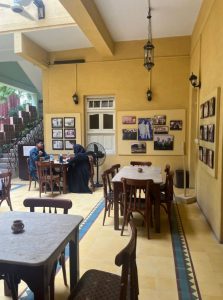
(Figure 2. 1)
The exhibits were accompanied by detailed information in both English and Urdu (Figure 2. 2) and throughout our visit we noticed that visitors consistently stopped to read the information provided. Artefact preservation measures were also evident through the use of glass display cases and clear “Do Not Touch” signage (Figure 2. 3) where appropriate.
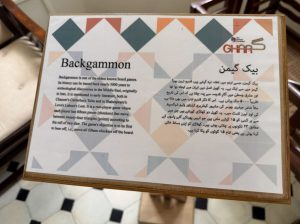
(Figure 2. 2)
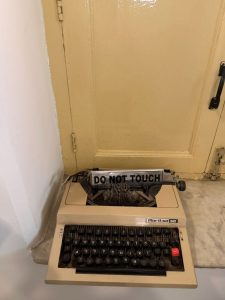
(Figure 2. 3)
During our observation between 3 and 4 p.m. on a Tuesday, there were around 14 women and 4 men present. We also observed three families, each with one child, alongside two couples, with the remaining visitors consisting primarily of women. TDF Ghar also demonstrates an active effort to engage the public through regular cultural events. Multiple posters advertising upcoming programmes, including three promotional posters for the “Karachi Kichri event”, were displayed throughout the building (Figure 2. 4).
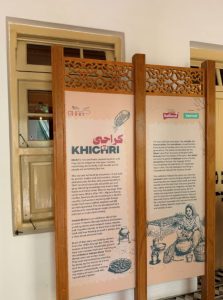
(Figure 2. 4)
A teenage student studying at the café described TDF Ghar as a “cozy environment. ” She also believed that the historical character of the building should remain unchanged as preserving its heritage is one of its greatest strengths. Another student studying at the library described that it was his favorite place in the city to come and study and he felt that the books at TDF ghar provided him with a vast amount of information. Another young woman explained that attending art exhibitions at TDF Ghar had strengthened her appreciation of both art and history, describing it as “an open space to connect. ” A first-time visitor attending with her family commented that the heritage building had been preserved exceptionally well and described the environment as peaceful, explained that the exhibits had helped her learn more about Pakistan’s history and expressed a strong intention to return. Another regular visitor noted that she had previously seen videos of events hosted at TDF Ghar and hoped to attend future programmes herself. She described the institution as “a very unique concept. “
Despite these strengths, several areas for improvement were identified. Although ramps and handrails were available, access to the upper floors was only possible via stairs which may present difficulties for elderly visitors and individuals with limited mobility. Directional
signage and room labels within the building were limited. Moreover, there was little signage guiding visitors to locations and no visitor brochures or maps were available during our visit. Lastly, there was also an entry fee of 150 rupees and an additional fee of 150 Rupees to enter the exhibit on the second floor
Field observations from Hilal park:
In terms of infrastructure, the park was proven to be well-lit, with an estimate of 38-lights surrounding the area providing visitors with a source of comfort and visiblity. The park provided a well-kept and organized sense of safety with security guards stationed outside the gate, albeit they are only present around 5:45 PM. We further found no stray dogs on the premises eliminating any rabid, animalistic threats. On the other hand, Hilal Park’s safety measures are limited in other areas. For instance, it lacks security cameras and surveillance systems to protect visitors during an emergency. One significant safety hazard identified was an open sewer (Figure 3. 1). Regarding infrastructure (Figure 3. 2), the park’s playground was well-maintained making it accommodating for families and engaging for children. Moreover, in terms of accessibility ramps surrounded the infrastructure aiding disabled people, whilst a number parking spots allowed a large number of people to come.
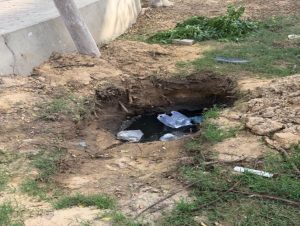
(Figure 3. 1)
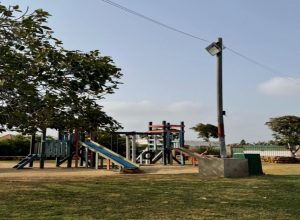
(Figure 3. 2) As shown in Figure 3. 3, numerous benches and trashcans were found, maintaining a clean and friendly environment with public facilities available in every corner. Washrooms for both men and women were available and well-kept.
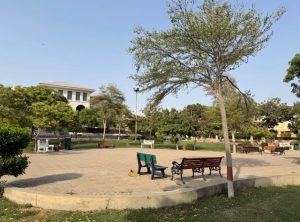
(Figure 3. 3)
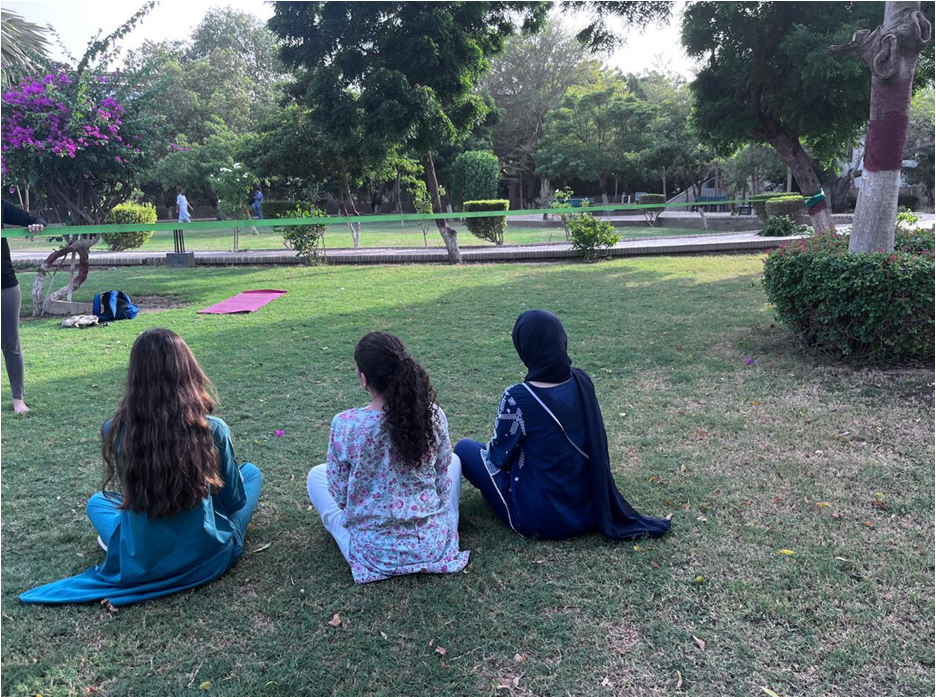
Multiple visitors showed satisfaction with the park as a relatively safe outdoor public space, with activities for all age groups. Additionally, an activity called ‘slacklining’ (see Figure 3. 4) was noted as a source of entertainment and physical activity. Facilitated by a local woman, this independent fitness class utilized slacklining as an engaging recreational tool that challenges core stability, balance, and cognitive focus.
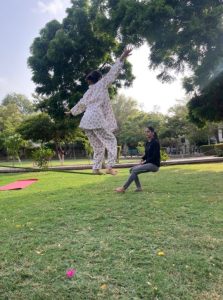
(Figure 3.4)
Recommendations for Hilal Park:
While Hilal Park offers multiple activities and a shared communal space, there is a need to increase safety and accessibility for visitors. As depicted in Figure 4. 1, the mismanagement of infrastructure has led to a run down bridge. This creates a structural barrier and poses a danger to unsuspecting visitors and children liable to injury. Our findings showed the broken-bridge to be easily accessible with no warning sign declaring caution, its run-down demeanor indicating years of neglect.
We also found an unsecured perimeter next to the children’s playground, presenting a safety hazard into the steep cliff area for unsuspecting children. To add on to the physical neglect, (refer to Figure 3. 1) the open sewer further creates environmental damage and pollution risking the health of park visitors. Implementing consistent upkeep, alongside temporary physical barriers and and signs prior to the bridge’s maintenance and creation of a physical barrier by the playground, will minimize risks and ensure public safety within the park.
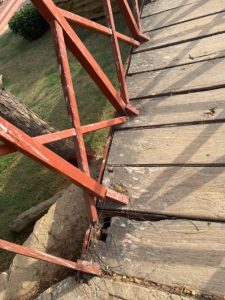
(Figure 4.1)
Recommendations for MGB park:
Physical signage at all entry points detailing opening hours, rules, and upcoming community activities, should be installed. Outreach efforts modelled after other successful public spaces like TDF Ghar could begin with establishing an active social media presence to keep residents informed regarding park events, maintenance updates and community initiatives. Additionally, MGB Park should diversify its recreational programming. This can be done by
incorporating flexible recreation options such as slacklining setups demonstrated at Hilal Park and designated board/card game areas. By expanding towards affordable popular activities a strong sense of community will be fostered which will encourage positive social interaction, discourage vandalism, and ensure the space caters effectively to all demographics.
Recommendations for TDF Ghar:
To ensure TDF Ghar remains welcoming to visitors of all abilities, accessibility to the upper floors should be improved. Installing ramps where feasible or introducing alternatives such as a lift would enable all visitors to experience the museum equally, creating a more inclusive and accessible cultural space. Improving navigation throughout the building would make the visitor experience more convenient and enjoyable. This could be achieved by installing additional directional signage, placing clear labels outside each room or providing maps at the entrance. To encourage visitors to spend more time at the museum the café could offer a wider selection of food and beverage options. Expanding the menu to include a greater variety of meals, snacks and drinks would cater to a broader range of preferences and enhance the overall visitor experience. Finally, introducing discounted tickets or concession rates for eligible visitors would make the museum more accessible to a wider audience while continuing to support its long-term sustainability.
Conclusion:
Our findings support the UN-Habitat’s view that accessible, inclusive, and well managed public spaces contribute to social well being and sustainable urban development. Based on the evidence gathered during this research, this memo recommends adopting a people-centric approach to public space planning in Karachi. Prioritising routine maintenance, improving accessibility, protecting cultural and environmental assets, and creating more opportunities for youth participation would enhance the quality and long term sustainability of public spaces. If such an approach is implemented, Karachi could strengthen social cohesion and cultural preservation, while creating environments that encourage interaction, creativity, and civic participation.
Bibliography:
● Ali, S. A. (2023). “Karachi’s largest park dilapidated beyond measure. ” The Express Tribune. Available at: https://tribune. com. pk/story/2397535/karachis-largest-park-dilapidated-beyond-measure
● Anwar, F. (2026). “Reclaiming public space. ” Dawn. Available at: https://www. dawn. com/news/1973552
● Business Recorder. (2026). “Rs63. 95bn KMC budget focuses on development projects. ” Business Recorder. Available at: https://www. brecorder. com/news/40427592/rs6395bn-kmc-budget-focuses-on-development-projects
● Costa, C. S. , Batista, J. S. , & Menezes, M. (2021). “What happens when teenagers reason about public open spaces? Lessons learnt from co-creation in Lisbon. ” Cidades, Comunidades e Territórios. Available at: https://journals. openedition. org/cidades/4887
● Forkby, T. , & Batsleer, J. (2020). “Beloved communities and zones of experimentation: Youth, informal spatial appropriation, and alternative belonging. ” Journal of Youth Studies. Available at: https://www. tandfonline. com/doi/full/10. 1080/17457823. 2020. 1716261#abstract
● Greene, S. , Burke, K. J. , & McKenna, M. K. (2016). Youth Voices, Public Spaces and Civic Engagement. Routledge.
● Haque, A. (2025). “The Politics of Heritage Conservation in Karachi. ” Journal of Architectural Conservation. Available at: https://link. springer. com/rwe/10. 1007/978-3-030-61493-5_264-1
● Hasan, A. (2019). “The Future of Karachi’s Public Spaces. ” Dawn. Available at: https://www. dawn. com/news/1503854
● Jurkevičienė, J. , & Budrytė, P. (2025). “Youth perception of public spaces in the city. ” Urban Science. Available at: https://www. mdpi. com/2413-8851/9/2/25
● Mazhar, M. , Agha, U. , & Khan, G. S. (2020). “Gated and commercialized: How Karachi’s public parks exclude the public. ” Dawn. Available at: https://www. dawn. com/news/1534648
● Moffat, C.
(2019). “History in Pakistan and the will to architecture. ” Comparative Studies of South Asia, Africa and the Middle East,. Available at: https://read. dukeupress. edu/cssaame/article-abstract/39/1/171/138757/History-in-Pakistan-and-the-Will -to-Architecture
● Niazi, F. , & Azad, A. P. (2018). “Investigation of ethnic diversity in Pakistan: A case study of Karachi. ” Journal of Basic & Applied Sciences. Available at: https://www. researchgate. net/publication/325983028_Investigation_of_Ethnic_Diversity_In_Pakistan_ A_Case_Study_of_Karachi
● Rafi, H. (2017). “TDF Ghar – A fresh public space near Quaid’s mausoleum. ” Dawn. Available at: https://www. dawn. com/news/1353029
● Shakir, M. (2025). “Balancing real estate development potentials and heritage conservation challenges of inner center using Karachi as case study. ” Urban Policy and Research. Available at: https://www. researchgate. net/profile/Masooma-Shakir/publication/400574785_Balancing_Real_Estate _Development_Potentials_and_Heritage_Conservation_Challenges_of_Inner_Center_Using_Karachi_ as_Case_Study/links/69a55585526cf2411930f5d0/Balancing-Real-Estate-Development-Potentials-andHeritage-Conservation-Challenges-of-Inner-Center-Using-Karachi-as-Case-Study. pdf
● Soomro, T. A. (2024). “Reflections on the importance of built heritage inventory as a tool for preservation in Karachi–a case study of Wadhumal Odharam (Jail) Quarter in Karachi, Sindh, Pakistan. ” Built Heritage. Available at: https://link. springer. com/article/10. 1186/s43238-023-00112-1
● United Nations. (n. d. ). “The 17 Goals. ” United Nations Sustainable Development Goals. Available at: https://sdgs. un. org/goals
● Karatsareas, P. (2022). “Semi-Structured Interviews. ” Research Methods in Language Attitudes. Cambridge University Press.
● Jacobs, J. (1961). The Death and Life of Great American Cities. Random House. Available at: https://archive. org/details/deathlifeofgreat0000jaco
● United Nations Human Settlements Programme (UN-Habitat). (2015). Global Public Space Toolkit: From Global Principles to Local Policies and Practice. UN-Habitat. Available at: https://unhabitat. org/global-public-space-toolkit
● United Nations Department of Economic and Social Affairs (UN DESA). (2019). World Urbanization Prospects 2018: Highlights. United Nations. Available at: https://population. un. org/wup/Publications/Files/WUP2018-Highlights. pdf
● Gehl, J. (2010). Cities for People. Island Press. Available at: https://islandpress. org/books/cities-people